advertisement
|
CURRENT NEWSSTAND ISSUERead the full Table of Contents for the issue on sale now! Click here Subscribe for only $1.84 an issue! Please tell us about yourself so we can better serve you. Click here to take our user survey. |
| |
![]() |
Life in the Fast Lane This collection of St.CroixÕs columns was assembled during the two years following his death of cancer in May 2006. Included are many of his most-read columns, as well as personal notes, drawings and photographs. Click for more books |
![]() Listen to these latest podcasts and more: |
|
eDeals Newsletter for Discounts on GearGet First Dibs on Hot Gear Discounts, Manufacturer Close-Outs and Job Opportunities when you sign up to receive eDeals E-newsletter, sent twice a month. Check out an issue get advertising info or subscribe |
|
A Little Knowledge
Since establishing Sausalito Sound at the beginning of 2000, almost all the projects that Harrison has produced have been done there. He's produced for Gary Lucas, No Doubt, O.A.R., Pink Spiders, and the Von Bondies. He recently recorded, produced, and mixed the music for 10 Days Out: Blues from the Backroads, a DVD and CD by Kenny Wayne Shepherd that features the blues guitarist traveling around the South visiting, interviewing, and playing with a variety of blues musicians. It was recorded completely on location (see Web Clip 1).
FIG. 2: Harrison playing his Clavia Nord Electro 2 in the control room with second engineer Matt Cohen adjusting the Digidesign Pro Control in the background.
The 5.1 mixes for the recent feature movie Stranger Than Fiction (Sony, 2006) and the award-winning Talking Heads boxed set Brick were also done at Sausalito Sound. Brick encompasses the group's eight studio albums in remastered stereo, high-definition stereo, and remixed into 5.1. The collection, which also features album outtakes, consists of a whopping eight dual discs. (The dual discs were also released individually in 2006.)
Sausalito Sound features an extensive collection of microphones and microphone preamps. Harrison states that the studio is in a kind of hybrid situation between the old-fashioned working methods and doing everything in-the-box. This is evidenced by the studio's three Dangerous Music Dangerous 2-Bus analog summing amplifiers, which are placed between the main Pro Tools system (run on the G5) and the second Pro Tools system (run on the 933 MHz G4) that Harrison mixes to. The Dangerous boxes introduce an analog link in the chain that is intended to dramatically improve the sound.
“I find that if you take things out of the box, they have more air,” explains Harrison's regular engineer, Eric “E. T.” Thorngren. “If you mix everything within one computer, the sound seems to collapse a bit. I'm used to mixing Pro Tools sessions via an SSL, and I always loved the way analog summing in the SSL sounded better than in Pro Tools. We searched around for something that could do the summing in Sausalito Sound and that wouldn't necessitate installing a large console, and we ended up with the Dangerous 2Bus. We bought two more when we did the 5.1 remixes for the Talking Heads. So we now have 48 inputs and 6 outputs that can feed our two 5.1 monitoring systems: one a Blue Sky system, and the other consisting of five [Yamaha] NS10s and a Meyer [Sound] subwoofer.”
In Harrison's view, plug-ins that imitate the effect of analog are the way of the future but not yet of today. “The need for running things through tape or going into the analog domain is less than it once was. But E. T. says that though many of the plug-ins are very good, when he goes back to using the original analog effects, they are still another step better. The only exception is plug-in EQ, which can be as good. But we're a bit old-fashioned here, and many of the Pro Tools outputs and inputs are prewired. So if you do an insert on a track, it can automatically go to an 1176, an Alan Smart, a Focusrite, or an LA1 or LA2. That being said, we often EQ or compress while recording using the preamps. It's better to make things sound good to begin with.”
For that reason Harrison recommends that personal-studio owners with limited financial means prioritize the acquisition of the best possible front end, rather than spend all their money on the latest-and-greatest DAW. “A lot of excellent and affordable all-in-one units by the likes of Avalon, Focusrite, and Universal Audio have come out in the past few years,” Harrison says. “I'm a fan of the Universal Audio remakes of 1176 and LA2A, LA3A, and LA4. The UA 2-610 is an excellent box, for instance. I'm also a fan of Grace [Design] equipment. I'm not very familiar with midrange microphones, but everybody should certainly own a Shure SM57. There are still times when it's the best vocal mic around.”
A Little Knowledge
Like everyone, Harrison has been strongly affected by the home-recording phenomenon. “Bands, particularly new bands, now think that they know everything,” he observes, “and they can be very stubborn about their stuff. People have their own digital setups at home, and when they come down to the studio here, they have the lingo down. But a little bit of knowledge can be a dangerous thing. If they are wrong, it can be very hard for me to explain why they are wrong, and things can turn into an argument.
“Every person who uses digital audio for the first time can get too perfectionistic. Just like with MIDI many years ago, you gradually realize that the most interesting aspect of music is that things are not perfect. I had to leave one project because the musician I was producing wanted to fix things way more than I wanted to fix them. So you learn to have a softer touch. Machines can be used to retain human feel or to suppress it.
“The primary focus should always be on the song. A lot of people think that they're ready if they have two parts to a song — a verse and a chorus. But that's just the beginning. You may also need an intro, a bridge, or a prechorus. Capturing a great performance is the next important thing; it can happen in a minute.
“One of the great things about digital recording is that you won't be running out of tape, so you can record as much as you like. Later you can go back and fix the most obvious mistakes that may have happened when you played with complete abandon. But it's important not to tweak too much. Sometimes a performance or a sound overrides any flaws in the recording. I demoed The Red and the Black on a 4-track cassette deck, and it also had some weird delays because it was recorded in a brick loft. When I transferred the demos to a 24-track tape recorder, I could not re-create them; so I used them, even though they were noisy.
“When working with bands, I always encourage them to go for the final sounds that they want. Sometimes when working in DAWs, people leave everything half—finished, thinking they can always change it later. But it's really nice when you put a song up and all the sounds are exactly as you want them to be. And if you're working on a less powerful system, the fewer channels and tracks that are playing, the better. If you have a lot of stuff playing, it may slow down the computer and you may start to get delays, which you can start to hear on some effects. Like suddenly the attack on the compressor doesn't quite work the way it should.
“Another problem with home studios is that people often lack good monitoring systems or quiet rooms, and they can miss hearing distortion on the recording. People often don't hear it until they come here or visit a mastering room, and the distortion suddenly becomes audible. That is why I strongly recommend that home-studio engineers invest in a good playback system. A good set of headphones may already make a difference, but something I particularly recommend is the Benchmark DAC-1 2-channel DA converter. It costs around $900, is a wonderful piece of gear that sounds great, has a volume control, and comes out at +4 dB, so you can run it through a power amp. The Benchmark is also a really good headphone amp.”
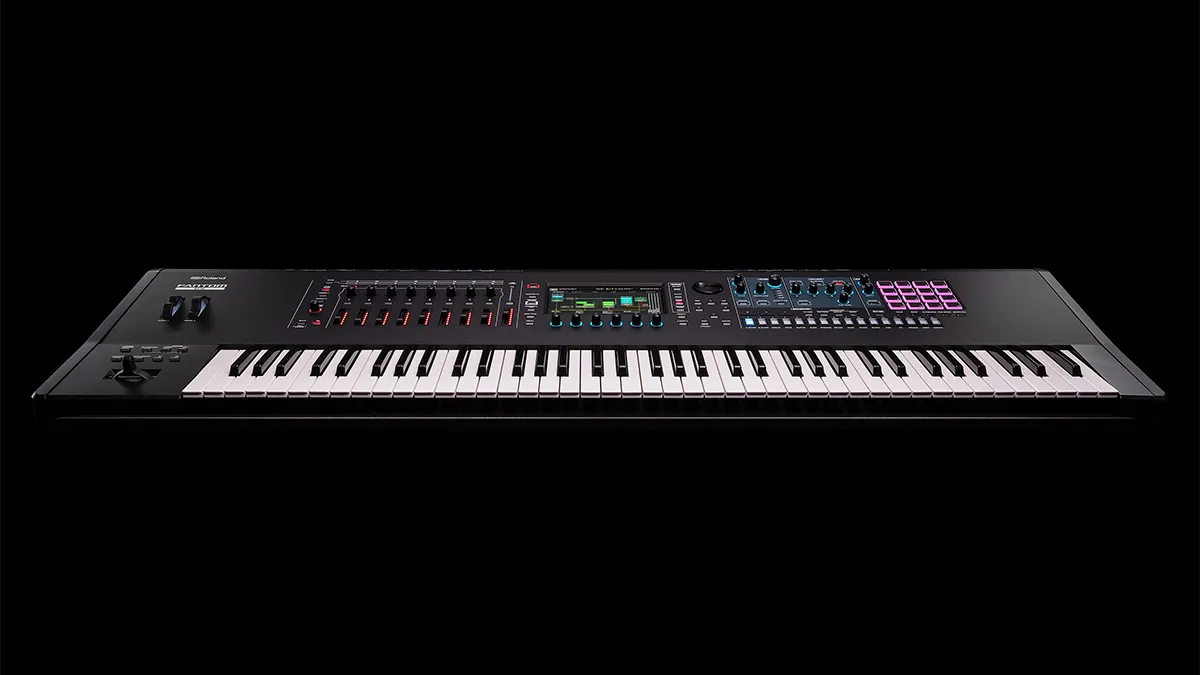
As a keyboardist, Harrison still prefers playing old hardware keys to soft synths. He's a fan of the Clavia Nord Electro 2 (see Fig. 2) and plays an Emu Emulator III, a Hohner Clavinet, a Nord Lead, a Sequential Prophet 5, a Sequential Prophet T8, a Waldorf Microwave, and a Wurlitzer. He says the reason for that has more to do with growing up turning knobs than with any inherent sonic flaws in the realm of soft synths. He's very impressed by the results that can be obtained with Arturia, Native Instruments Reaktor, and Propellerhead Reason synths.
Reflecting on the changes brought about by digital technology, Harrison bemoans the emergence of music that's “like a commodity,” with individual tracks downloaded in lossy formats — a bit like the aural equivalent of fast food. “In a way, we are going back to the '50s, when you had to buy singles and when albums were single compilations.” He thinks that MP3 and AAC are great for “finding out what songs sound like” and that they're convenient in noisy surroundings such as airplanes and public transport.
“As I said,” concludes Harrison, “the most important thing is a great song; a great performance is second. The equipment you use is in many ways a distant third. So I do everything I can to give musicians the space and time to redo things if they want to. Recording budgets have become smaller over the years, so having my own studio is helpful here. I never thought of it as a way to make money; it really is a place to aid the creative process.”
Paul Tingen is a writer and musician living in France. He is the author of Miles Beyond: The Electric Explorations of Miles Davis, 1967-1991 (Billboard Books, 2001), a book on early weird funk experimentation. For more information, visit www.tingen.co.uk.
Go to the next page for a list of Jerry Harrison's gear and his discography.
Acceptable Use Policy blog comments powered by Disqus
Want to use this article? Click here for options!
© 2009 Penton Media, Inc.