Audio Insider
Online Monthly Pass

Register for an Account Forgot your Password?

Most Popular


The EM Poll


This is not a scientific poll but a tabulation of readers responses and is purely just for fun!

See Past Poll Results


Article Index head

browse back issues

Newsletters

emusicianXtra icon
EMSoftware update icon
MET Extra icon
eDeals Newsletter icon


Subscribe to newsletters here...

It's Only Make-Believe

Jun 1, 2007 12:00 PM, By Mike Levine


         Subscribe in NewsGator Online   Subscribe in Bloglines

CURRENT NEWSSTAND ISSUE

Read the full Table of Contents for the issue on sale now! Click here

Subscribe for only $1.84 an issue!

Please tell us about yourself so we can better serve you. Click here to take our user survey.

Personal Studio Series

Mastering Steinberg's Cubase™

This special issue is not only a must-read for users of Cubase™ software, but it also delivers essential information for anyone recording/producing music in a personal-studio.

Click for more
EM Podcasts

Listen to these latest podcasts and more:
Engineer Chuck Ainlay on his mixing techniques. Go

What's New: Sony Creative sound library, Expanse Refill for Reason, more. Go

eDeals Newsletter for Discounts on Gear

Get First Dibs on Hot Gear Discounts, Manufacturer Close-Outs and Job Opportunities when you sign up to receive eDeals E-newsletter, sent twice a month. Check out an issue get advertising info or subscribe

The sounds that you hear in movies, TV, and video games fit so seamlessly with the visuals that it's easy to forget just how much work goes into producing them. Whether the sound you're hearing is a bomb exploding, a spaceship taking off, or silverware clinking, you can bet that a lot of effort was put into designing and recording those sounds.

One of the preeminent sound designers working today is Scott Gershin, who has worked on many major motion pictures including American Beauty, the Chronicles of Riddick, and Shrek and a host of video games such as the James Bond and Mechwarrior series and Lost Planet: Extreme Condition. Gershin is the executive creative director of Soundelux Design Music Group, a postproduction sound company located in Hollywood, California. He is also the cofounder of the Interactive Entertainment Sound Developers, a new branch the Game Audio Network Group. I had the opportunity to speak with him recently about his work, his gear, and his techniques.

Is the term sound designer a good way to describe what you do?

Sure, but sound design has become a very generalized and overused description. There are music sound designers, theatre sound designers, movie sound designers, game sound designers, and dialogue designers. What I do is take a look at the story or the action that I'm dealing with, and [then] use and manipulate sound to help tell the story or enhance the experience of the movie goer or game player. My job is to use sounds, whether captured from real life or manufactured and manipulated, to push the emotional buttons of the audience.

Are you always working with a visual component?

Mostly.

Our readers are interested in the nuts and bolts of how you create sounds. Let's take, for example, a film situation. Can you describe your work flow? That is, when do you start preparing, and when do you see materials or visuals?

Every film is a little different, but in a nutshell, I'll receive a script or a rough version of the film. I'll go through the script or video and start looking at potential audio opportunities. Sometimes the movie is already being shot when I get the script; other times, it's still in preproduction. In the latter case, I'll try and sit down with the director and talk about audio opportunities during filming that we might be able to record. If he or she is going to be filming large crowds, weapons, special vehicles (armored attack vehicles, race cars, aircrafts, submarines, and so on) or something that's unique and hard to get access to, then I'll recommend we go out and record those sound sources during the filming, as well as [during] those days before, between, and after the filming of those scenes.

You're talking about recording at the set of the movie?

FIG. 1: Gershin (left) and Peter Zinda mic the avionics of a jet plane while gathering sonic material for the Chronicles of Riddick.

Yes, I do it quite often. On Herbie: Fully Loaded, the second unit had full access to California Speedway filming the NASCAR race. I discussed this opportunity with the director and Disney, and they gave my crew and me full access. On one of the days, there was cloud cover at the speedway; they couldn't match the scene previously shot with the actors, so they had to wait while the weather cleared up. That gave us a chance to wire the cars up, race them around the track, and get some amazing recordings. Disney also built 30 different Herbies to use in different parts of the film. Each one had a slightly different engine setup, so I auditioned them and chose four that I thought had unique sounds. We miked them up and spent days just recording Volkswagen Herbies at an airfield we rented north of Los Angeles. We installed switches in the car that allowed us to turn different spark plugs on and off, giving us the ability to record a palette of sounds to help create Herbie's “emotions.”

Which do you use for your remote recordings — field recorders or laptops?

I'm using mostly field recorders. I've tried laptops, but because of battery issues and glare, I've found them a little inconvenient. Most of the time I need to be fast, flexible, and agile. When I go out to record, I use multiple recorders and a team of recordists covering different perspectives of the sound, similar to a multicamera shoot (see Fig. 1). We use a combination of Sound Devices 744s (see Fig. 2) and Fostex FR-1s. Sometimes we'll use a [Zarcom Audio] Deva V or a Nagra. Microphone choices depend on what we're recording; each mic has a different color, reach, and purpose. We choose the right mics for the right purpose, similar to tracking an album. I just bought a Sanken 5-channel microphone, which I've been quite impressed with. Between Soundelux, myself, and the guys I record with, we have a very impressive mic arsenal to choose from.

Once you're done gathering raw material, where do you go to work on the sounds?

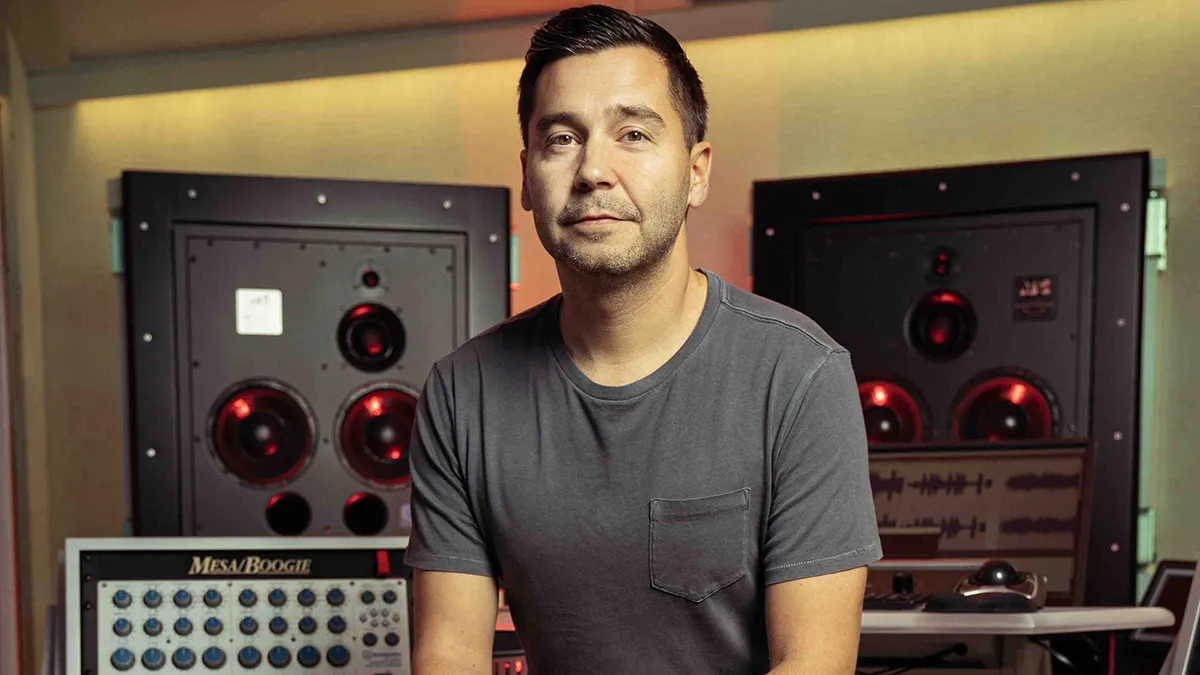
The studio that I work out of most is at Soundelux, although I also have a setup at home. The Soundelux studio is a minitheater; it's about 30 feet long and 24 feet wide with a full screen in front. I'm surrounded by computers, outboard gear, controllers, and anything that can manipulate sound (see Fig. 3).

Do you want the room to sound kind of like a theater does?

I try to simulate as much as possible the environment that the sound is going to play back in. So I've got my film set of speakers, and I've also got another set of speakers for my video-game work.

Are those other speakers studio monitors?

Yeah, my mid/close-fields. I'm using JBL LSR32s with a Bryston amp.

I actually have four speaker setups that I use. I have my EAW theater speakers behind the screen, my JBL LSR32s on stands at my main studio, and a 5.1 Dynaudio Air system that I run digitally out of my Pro Tools setup in my second studio. For critical listening, I also use my home-theater setup in which I'm using Thiels and a Sunfire sub.

Get Copyright ClearanceWant to use this article? Click here for options!
© 2008 Penton Media, Inc.

Back to Top