Square One: Snap, Crackle, Pop
Aug 1, 2008 12:00 PM, By Brian Smithers
HOW AUDIO RESTORATION CAN UNDO THE DAMAGE OF AGE AND ABUSE
advertisement
|
CURRENT NEWSSTAND ISSUERead the full Table of Contents for the issue on sale now! Click here Subscribe for only $1.84 an issue! Please tell us about yourself so we can better serve you. Click here to take our user survey. |
| |
![]() |
Life in the Fast Lane This collection of St.CroixÕs columns was assembled during the two years following his death of cancer in May 2006. Included are many of his most-read columns, as well as personal notes, drawings and photographs. Click for more books |
![]() Listen to these latest podcasts and more: |
|
eDeals Newsletter for Discounts on GearGet First Dibs on Hot Gear Discounts, Manufacturer Close-Outs and Job Opportunities when you sign up to receive eDeals E-newsletter, sent twice a month. Check out an issue get advertising info or subscribe |
|
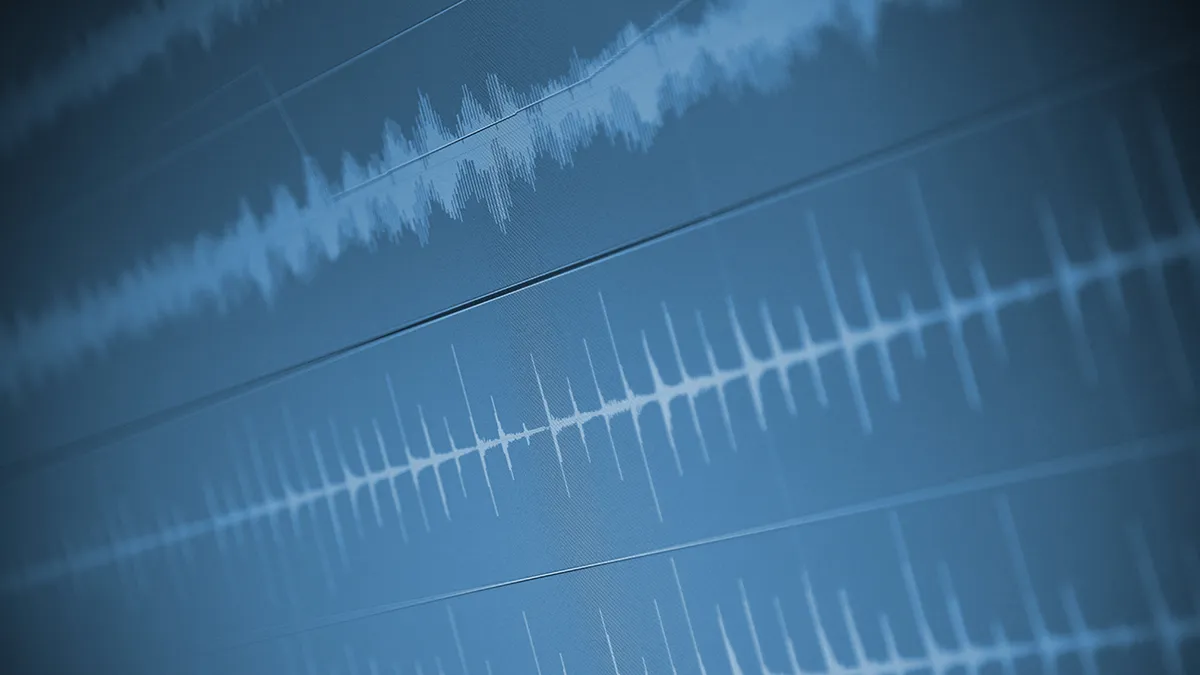
FIG. 1: This screen shot shows some of the unpleasant damage you see when transferring old tapes or vinyl records for preservation, repurposing, or archiving. Fixing such damage is the object of audio-restoration software.
Is the saying goes, stuff happens. No matter how hard we try to avoid it, a steady chain of events works to degrade every recording we make (see Fig. 1). Recording devices and analog media introduce noise into a recording, then media break, scratch, and wear. At some point, the accumulation of those effects makes us need to look for ways to restore the original glory of a valued recording. And that's where the art and science of audio restoration comes in.
Various techniques, such as the RIAA curve for vinyl or the various Dolby noise-reduction methods for tape, are employed to improve the performance of recording devices. But audio restoration is used when the damage has already been done and such preventative processing is no longer an option. Analog techniques exist: for example, if you have two damaged source copies, you can splice them together to circumvent the flaws in each. And there are 2-stage analog declickers, which are designed to find clicks using a highpass filter and then reduce them by engaging a lowpass filter.
The use of digital signal processing (DSP) has brought great advances to the field of audio restoration and has simultaneously opened it to a much wider audience. Even very inexpensive software now includes tools to remove clicks and hiss from recordings, making it easier than ever before for users to create good-sounding digital files from their favorite LPs. More-sophisticated versions of these tools are being used to archive and restore recordings of great historical, commercial, and cultural value.
Meet the Enemy
FIG. 2: A click is immediately apparent by its contrast with the surrounding music waveform, and intuitively just as easy to fix by interpolation.
The damage that occurs to recordings — whether as a result of the recording/reproduction process or the physical degradation of the medium — can be broadly divided into two categories: short-term damage and long-term damage. Short-term damage includes clicks (see Fig. 2), crackle, thumps, and pops; long-term damage includes hiss and wow, or speed fluctuations. (Distortion is another type of damage, but one that is primarily beyond our current capabilities to repair.)
In some cases the damaged signal consists of the original signal and an undesirable signal, but in other cases the damage obliterates the original signal, leaving nothing but the noise. To fix the former type of damage, you attempt to remove the noise and leave only the undamaged original; to fix the latter type, you try to reconstruct the missing part of the original. In both cases, however, you must first find a way to distinguish the noise from the original signal.
It turns out that the best tools for the job are your ears. Even the untrained ear can easily distinguish between the sound of music and that of tape hiss, clicks, and pops. If you are properly motivated, as when listening to a distant broadcast or a worn-out recording of a favorite musician, you can discard the interference and savor only the original signal. Audio-restoration software attempts to mimic this innate human talent through carefully crafted DSP algorithms.
Divide and Conquer
Several methods are available for detecting clicks, crackle, and other similar noises. Clicks are primarily composed of high-frequency energy, so if you run the signal through a highpass filter, you can remove the useful energy and see only the clicks. Clicks have an extraordinarily short rise time, so you can analyze the waveform with wavelet filters (which see a signal in both the frequency and the time domain), and then flag the points that look like cliffs.
Algorithms exist that can dependably predict the behavior of a music waveform based on its prior shape. When a click occurs, that prediction will prove to be quite wrong. This sort of time-domain modeling of the waveform borrows from the fields of probability theory and random-signal theory. It is one of the major advancements in restoration and continues to be a hot topic of research.
Once a click is found, the simplest fix is to interpolate between the last good sample before the click and the next one after. Some more-advanced algorithms first dissect the signal on a frequency basis (by doing a discrete Fourier transform), and then interpolate within each frequency bin (storage unit) before reconstructing the signal.
In using interpolation, however, you assume that the original signal is unrecoverable. If you believe the signal is recoverable, you can attempt to remove the click. The trick is to know which part of the damaged signal is good and which is bad. One solution is to model the behavior of the click based on the analysis of similar noises. You can then subtract the estimated spectrum of the noise from the damaged signal, leaving only the original.
Making Hiss-tory
Eliminating hiss and other sorts of steady-state noise requires a different set of tools. Although lowpass filtering can reduce the most obvious part of hiss, it often dulls the original signal in the process. To avoid having that happen, hiss-detection algorithms first divide the signal into time slices, typically looking at windows of either 1,024 or 2,048 samples. At each window (or frame), the signal is then separated into frequency bins. If this sounds a lot like the sort of frequency coding that goes into many perceptual data-reduction codecs, it is. What we do with these frequency bins is different, however.
Want to use this article? Click here for options!
© 2009 Penton Media, Inc.
Acceptable Use Policy blog comments powered by Disqus