Steven Wilson Interview
Mar 1, 2009 12:00 PM, By Mike Levine
THE PORCUPINE TREE GUITARIST/VOCALIST EXPRESSES HIS ECLECTIC MUSICAL VISION ON HIS SELF-RECORDED SOLO PROJECT
advertisement
|
CURRENT NEWSSTAND ISSUERead the full Table of Contents for the issue on sale now! Click here Subscribe for only $1.84 an issue! Please tell us about yourself so we can better serve you. Click here to take our user survey. |
| |
![]() |
Life in the Fast Lane This collection of St.CroixÕs columns was assembled during the two years following his death of cancer in May 2006. Included are many of his most-read columns, as well as personal notes, drawings and photographs. Click for more books |
![]() Listen to these latest podcasts and more: |
|
eDeals Newsletter for Discounts on GearGet First Dibs on Hot Gear Discounts, Manufacturer Close-Outs and Job Opportunities when you sign up to receive eDeals E-newsletter, sent twice a month. Check out an issue get advertising info or subscribe |
|
Not to mention that the “album” as a concept is not as big as it used to be due to downloading.
Right, that’s the other thing. We talk about what I call the “jukebox mentality,” where you download a couple of songs off the record, but the whole idea of the album as a continuum, or a musical journey—you think of the great albums like your Pet Sounds or your Sgt. Pepper or your Dark Side of the Moon—these were albums that were conceived to be listened to from start to finish as a kind of musical journey. But now, of course, you’ve got kids who are not familiar with that whole kind of approach, that whole kind of aesthetic—the 50-minute musical journey. It’s just download a couple of songs and program it into a playlist.
And then there’s the artwork that used to be on albums. I saw a book of CD covers from classic Blue Note albums, and that stuff was amazing. The CD and, to a larger extent, downloading have killed album art.
Yeah, the whole idea of the artist or the musician extending their creativity through to the way their music was packaged is becoming less and less prevalent. And that, for me, is quite depressing. So we talk about that in the film, we talk about packaging, we talk about artwork and all those things I grew up with—gatefold sleeves and novelty sleeves. I don’t even know if the younger generation can conceive of music having a physical form these days.
Let’s talk a little bit about your studio. How big is the actual room?
FIG. 5: Wilson recorded the vocals for the album in his studio using his Neumann U87.
Credit: Photo: Steven Wilson
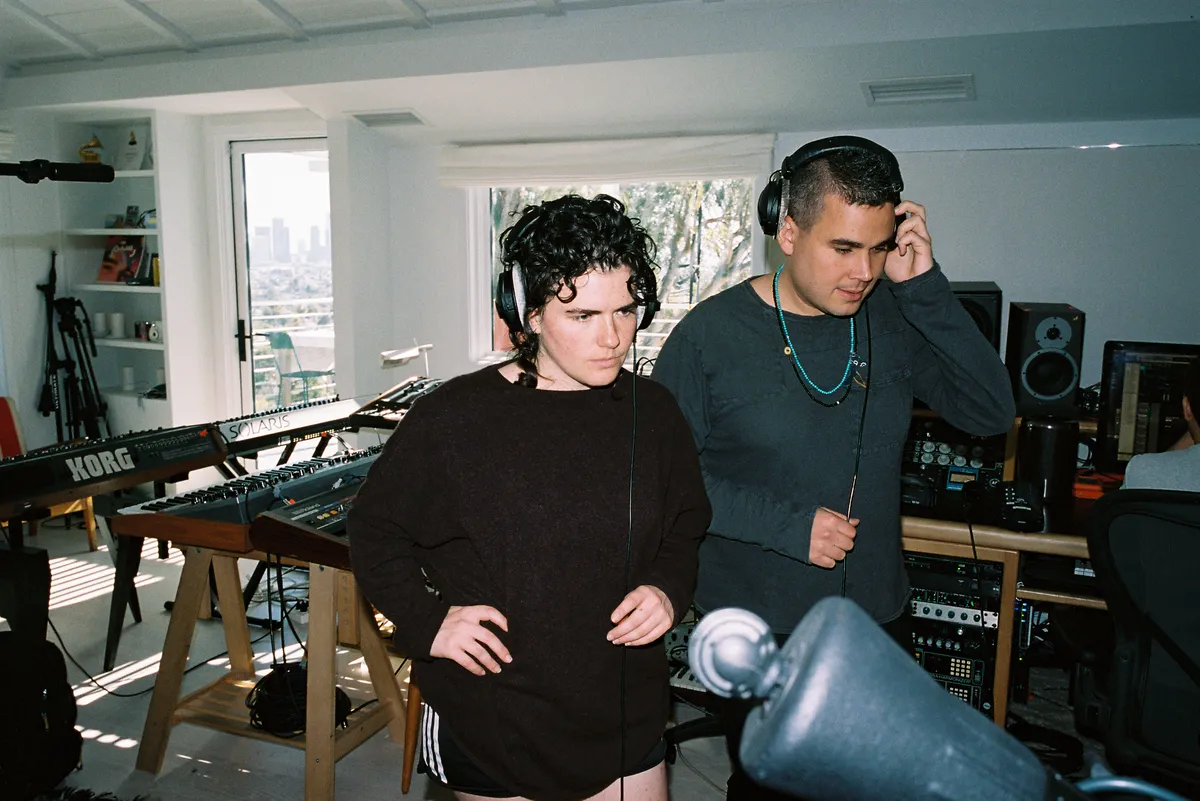
My “studio” is not really a studio at all. It’s a computer. That is my studio these days. Now that’s not to say that over the years I haven’t had studios with outboard equipment and mixing desks and all that stuff. And I have to say that I’m a big fan—and this is where I may sound like I’m being a hypocrite—I’m a big fan of digital recording. And a lot of my music is very much influenced by digital recording techniques and digital editing and the facilities that gives me; plug-ins as well. So in terms of the studio, these days I have one great A/D, which is an Apogee Trak2, and I have a great microphone, a Neumann U87 [see Fig. 5], and that’s about it. I have my collection of guitars, of course, and I have a piano. The rest, really, is taking place inside a computer, which is a G5 running [Apple] Logic Pro 7 at the moment.
But the physical space you record in is a room in your house, right?
It is, and it’s a fairly small room. And actually, it’s not in my house, it’s in my parents’ house. It’s the room I grew up in. In some respects, I’ve never left home, because I still go back to the room that I grew up in to write, to record, and to mix.
What kind of monitors do you use? And do you mix in there?
I do mix in there. When I’m doing surround, I use five Genelec speakers and a Genelec sub. On the stereo side, I’m also monitoring through the Genelecs, and I have a pair of Yamaha NS-10s. I have a pair of Quested monitors as well. And I’m always comparing on different speakers. It’s one of those things where it’s not the greatest room, it doesn’t have the greatest acoustics, but I know exactly how it should sound in there.
When you mix surround and also do a stereo mix of the same material, which one do you generally do first?
I always do stereo first, because when you get to the point where you’re happy with the stereo mix, the surround mix becomes a breeze, because all you’re doing at that point is placement. You’ve set up the EQs, you’ve set up the effects, you’ve set up the volume balance. And with a little bit of adjustment—because obviously, perspectives do change when you start breaking things out into 3-D, particularly with volume—you have your surround mix, just with a little bit of placement. So always I work to perfect the stereo mix, which can take weeks. And then the surround mix usually only takes another day, because you’re having a ball, you’re just kind of flying stuff around the room.
I guess if you did it the other way around, it would be kind of depressing to do the stereo mix.
It would be really depressing. Because once you’ve heard surround, it’s really hard to go back. It’s like going from 3-D to 2-D.
What about the drums on this album? Were they recorded in your studio as well?
No, they were done at the drummer’s own studio. Now the drummer, Gavin Harrison, who also happens to be the drummer in Porcupine Tree, has a very similar situation to myself. He spent years and years experimenting in his home studio with microphones, with positioning, with preamps, and has arrived at a system that’s permanently set up in his studio. He has a very big room in his studio, a soundproof room. And he does all of his drum tracking there.
Want to use this article? Click here for options!
© 2009 Penton Media, Inc.
Acceptable Use Policy blog comments powered by Disqus