Most Popular


The EM Poll


CURRENT ISSUE

SUBSCRIBE
$1.84 an issue!

EM DIGITAL EDITION
Try it for free today!

browse back issues


Follow Us On...


Rhythm and Noise | John McEntire

Dec 1, 2008 12:00 PM, By Rich Wells


         Subscribe in NewsGator Online   Subscribe in Bloglines
 

FROM POP TO EXPERIMENTAL, IT'S ALL IN A DAY'S WORK FOR ENGINEER-DRUMMER JOHN MCENTIRE

BONUS MATERIAL
More Interview With John McEntire

CURRENT NEWSSTAND ISSUE

Read the full Table of Contents for the issue on sale now! Click here

Subscribe for only $1.84 an issue!

Please tell us about yourself so we can better serve you. Click here to take our user survey.

MixBooks Logo
Life in the Fast Lane

This collection of St.CroixÕs columns was assembled during the two years following his death of cancer in May 2006. Included are many of his most-read columns, as well as personal notes, drawings and photographs.

Click for more books
EM Podcasts

Listen to these latest podcasts and more:
Bela Fleck on recording Jingle All the Way.Go

What's New: software and sound products. Go

eDeals Newsletter for Discounts on Gear

Get First Dibs on Hot Gear Discounts, Manufacturer Close-Outs and Job Opportunities when you sign up to receive eDeals E-newsletter, sent twice a month. Check out an issue get advertising info or subscribe

Dan, Johnny, and I [under the name Bumps] recently made a breakbeat record [Bumps; Stones Throw, 2007]. It's just the three of us doing drumbeats, and they run the spectrum from kind of trad funk/disco sounding to really, really freaked. But in both Bumps and Tortoise, the things we're working on now tend to be more about interplay, letting the parts breathe, and creating interesting counterpoint.

Let's talk briefly about how you set up to record at Soma, starting with drums.

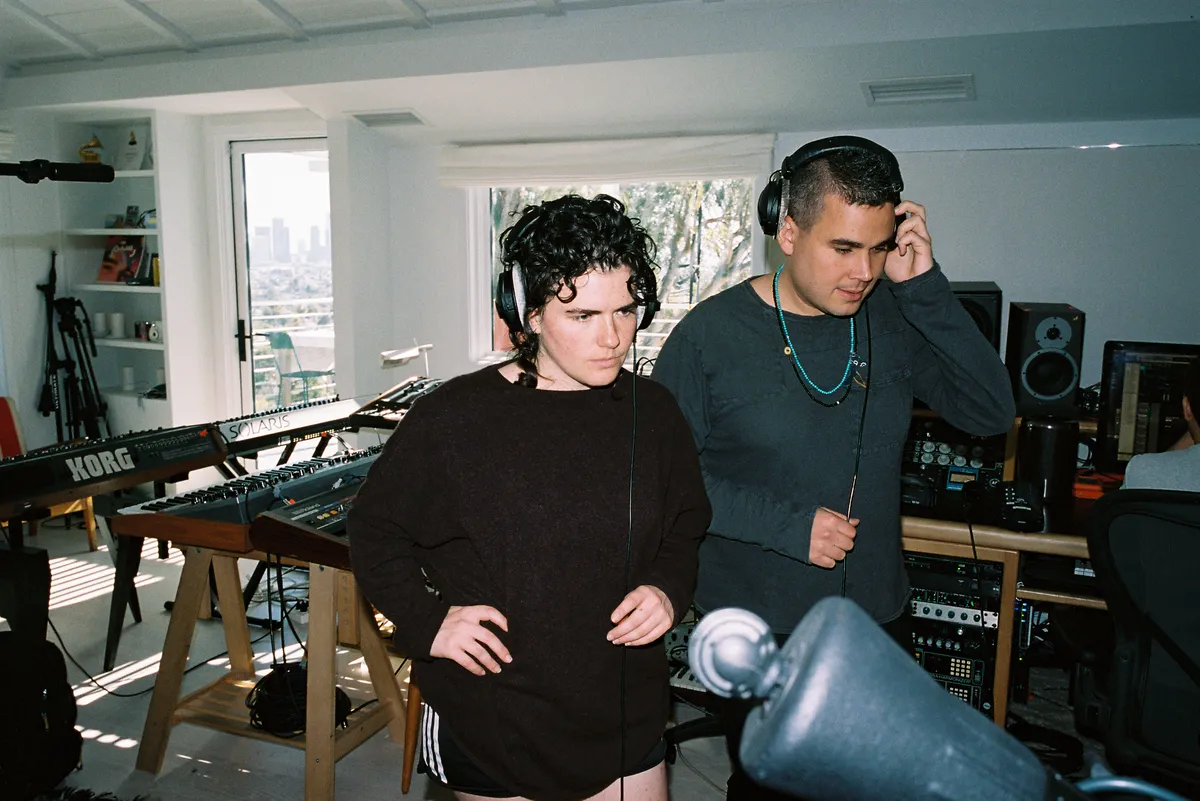
Recording unusual instruments is one of McEntire’s specialties. Here, he’s miking a hammer dulcimer with a pair of small-diaphragm condensers.

Recording unusual instruments is one of McEntire’s specialties. Here, he’s miking a hammer dulcimer with a pair of small-diaphragm condensers.

The first consideration is whether we want it to be superdry or to have the possibility of utilizing room ambience, and that will dictate the physical location of the kit. In either case, I tend to prefer — and rely on — close-mic setups. In addition, I'll usually print more tracks than I need. Obviously there's a little bit of trial and error involved in every setup — swapping mics out and moving things around. And on rare occasions, I'll do a minimalist setup, with just two to four mics for the whole kit. It all depends on the song and how the artist and I foresee approaching the mix.

The choice of what mics I'll use depends on how the drums are tuned and the player's style. In general I tend to like condensers on snare and toms, unless we're talking about a really loud player or toms that are tuned very low. In either of those cases, I'd probably reach for dynamics from the get-go. For snare, I tend to like the Schoeps CMC6 with a hypercardioid capsule. That or an AKG C451 with a Blue Red C-12-style capsule. A dynamic mic that I really like on snare is the Sennheiser MD441, which is also hypercardioid. I find that pattern to be a big help. I think most people will agree that it's a constant battle to fight hi-hat spill in snare tracks. Shure SM57s will work in a pinch, and occasionally you'll get a particular drum that will sound really good with a 57. On the resonant side, I'm not too picky. I might use a microcondenser like an SM98, or a 441, or a 57.

In terms of overheads, I'll usually do some sort of stereo setup, either a single stereo mic such as a Neumann SM2 or an AKG C422, or a pair or whatever happens to seem most suitable given the situation. For a long time I just did a simple XY, crossed-cardioid setup, but lately I've been really fond of using an M-S pair for this application, as I like having the imaging options be more flexible during mixdown. In addition, I'll usually set up a spot mic on the ride and another on the hi-hat side, because sometimes it's helpful to have a little more definition on those elements.

Kick drum mics vary a lot. For a long time, on the batter side I would use a dynamic mic outside the drum, next to the pedal, pointed right at where the beater hits the head, and then I'd use a large-diaphragm condenser on the resonant side. Even if there was a hole in it, I'd put the mic on the head, not inside the drum. Recently, though, I picked up an AKG D12e, and I've been using that inside the shell, pointed where the beater hits the head, usually at a bit of an angle. I've been liking that a lot as a single source, or again sometimes with a condenser, placed a little further out. Occasionally I'll use a Yamaha Subkick instead of the condenser. It doesn't sound like much on its own, but it can add something really great in the mix. I've also used the Subkick on bass amps as well, blended with a mic or DI signal.

Over the years, I've used all the rooms here for recording drums, including the control room. In fact, all of the Sea and Cake records that we've done here (with the exception of the newest) had the drums tracked in the control room.

And sometimes I like to do little experiments. For instance, I might set up a mono mic somewhere weird, either somewhere out on the floor, or just over the player's shoulder, or way off in the corner somewhere. The idea being to capture something slightly unusual that might be useful later, either heavily processed or just to provide a strange representation of the kit that could be sent to a reverb, for example. Sometimes that's useful, but other than that, I usually stick to the tried-and-true 10- or 12-mic setup.

How do you go about recording electric guitar?

Usually I start with a standard combination of dynamic and ribbon mics, though of course it depends on the player, the amp volume, and overall sound. Most of the time, I'll have the two mics right next to each other, pointed at the middle of the cone, 4 or 5 inches away. Sometimes I'll use a distant mic, though not very often; for one reason or another I tend to use outboard gear for spatial processing. And sometimes I'll use a splitter and run two or three amps in parallel. Again, it depends on the song and the types of options we need to have available during mixdown.

Get Copyright ClearanceWant to use this article? Click here for options!
© 2010 Penton Media, Inc.


Acceptable Use Policy
blog comments powered by Disqus

Back to Top