Audio Insider
Online Monthly Pass

Register for an Account Forgot your Password?

Most Popular


The EM Poll


This is not a scientific poll but a tabulation of readers responses and is purely just for fun!

See Past Poll Results

pop_quiz_button

browse back issues

Newsletters

emusicianXtra icon
EMSoftware update icon
MET Extra icon
eDeals Newsletter icon


Subscribe to newsletters here...

Man vs. Machine: Conny Plank

Jul 12, 2007 2:48 PM, By John Diliberto


         Subscribe in NewsGator Online   Subscribe in Bloglines

CURRENT NEWSSTAND ISSUE

Read the full Table of Contents for the issue on sale now! Click here

Subscribe for only $1.84 an issue!

Please tell us about yourself so we can better serve you. Click here to take our user survey.

Personal Studio Series

Mastering Steinberg's Cubase™

This special issue is not only a must-read for users of Cubase™ software, but it also delivers essential information for anyone recording/producing music in a personal-studio.

Click for more
EM Podcasts

Listen to these latest podcasts and more:
Engineer Chuck Ainlay on his mixing techniques. Go

What's New: Sony Creative sound library, Expanse Refill for Reason, more. Go

eDeals Newsletter for Discounts on Gear

Get First Dibs on Hot Gear Discounts, Manufacturer Close-Outs and Job Opportunities when you sign up to receive eDeals E-newsletter, sent twice a month. Check out an issue get advertising info or subscribe

This article originally appeared in the February 1987 issue of Electronic Musician.

Artists from Kraftwerk to the Eurythmics to KillingJoke have come to Corny Plank to produce and engineer their records. If you think it's because he's a production wizard whose ability to make electronic sounds come to life on vinyl has made Conny a legend in German electronic music circles and a savant to a younger generation of Anglo-rock musicians, you might be right.

But it could be his burly, Papa Bear cuddliness. Standing at a lumbering 6'4", looking like a center for the New York Giants, Conny rules over his studio with Buddha-like serenity, his enthusiasm and joy contained behind a bemused grin.

In Conny's Cologne studio, German new-wave composer Arno Steffens is bounding off the walls, extolling the technological tricks of a new angst-ridden track we're hearing on playback. "You hear that bass drum?" he exudes. "That's the hood of a Cadillac being slammed," he gesticulates wildly. "Only old American cars have that power." Conny meanwhile, sits quietly, an ever-present cigarette sandwiched in his stubby fingers, a twinkle glimmering behind his sleepy, pale blue eyes as he casually explains how none of the music on Arno's record, Schlage, comes from real instruments, but instead are natural sounds sampled into his Emulator II. The track is massive. Huge percussive chunks roar out of the giant JBL monitors in a battering ram of rhythm.

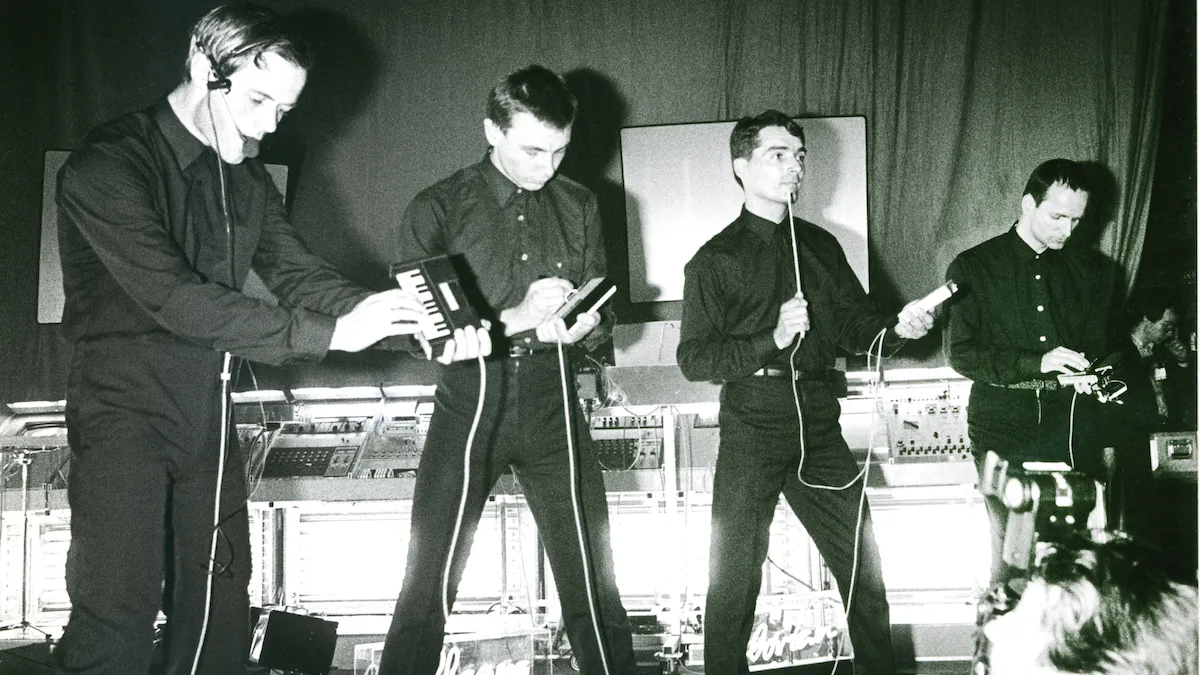
You probably haven't heard Arno Steffens, whose records aren't released in the U.S., but no doubt you've been floored by some of Plank's other work with Ultravox, Kraftwerk, KillingJoke, the Eurythmics, Deutsche Americanisher Freundschaft (DAF), Holger Czukay, and Cluster. Whether using synthesizers and computers or recording German folk groups, Conny has a unique understanding of how to create that elusive "theatre of the mind."

Like most of the electronic German generation, Conny was born of '60s psychedelic, given vent in the electronic music studios of West German Radio in Cologne. As an engineer, he worked with icons of 20th century music like Karlheinz Stockhausen and Mauricio Kagel. In the late, after-sessions hours, Conny experimented with classical musicians. Sitting at the mixing console, he generated free-form compositions, sending out echoes and filtering changes in real time. The results can be heard on a Deutsche Grammophon boxed set called Free Improvisation, with a group aptly called Wired. "It was like dub-mixing,' explains Conny, "but live dub-mixing so it was an improvisation together."

A rudimentary musician himself, Conny's creativity comes at the mixing console. Whether listed as producer, engineer or musician, his impact is crucial. He shaped the sounds of the first four Kraftwerk albums, including the international hit, Autobahn.

Nearly anyone touching a synthesizer in the Cologne-Düsseldorf region came to Conny. His relationship with the Cluster-Harmonia-Neu axis even led to him recording as an artist with Dieter Moebius from Cluster (Rastakraut Pasta, Material, and Zero Set, all on Sky).

His work with these seminal electronic ensembles was heard by the post-new wave generation of British musicians who'd opted out of the rudiments of punk and exhausted the limits of Euro-disco. Ultravox recorded their brilliant swan song with John Foxx, Systems of Romance (Antilles), and returned to Conny's Studio for their comeback, Vienna (Chrysalis). The success of Vienna and its successor, Rage In Eden (Chrysalis), were due in no small part to the edgy, nearly psychedelic environment that Conny generated in the studio.

After two recordings, Quartet (Chrysalis) and Lament (Chrysalis) produced by George Martin and themselves respectively, Ultravox has returned to Conny's Studio for their forthcoming album.

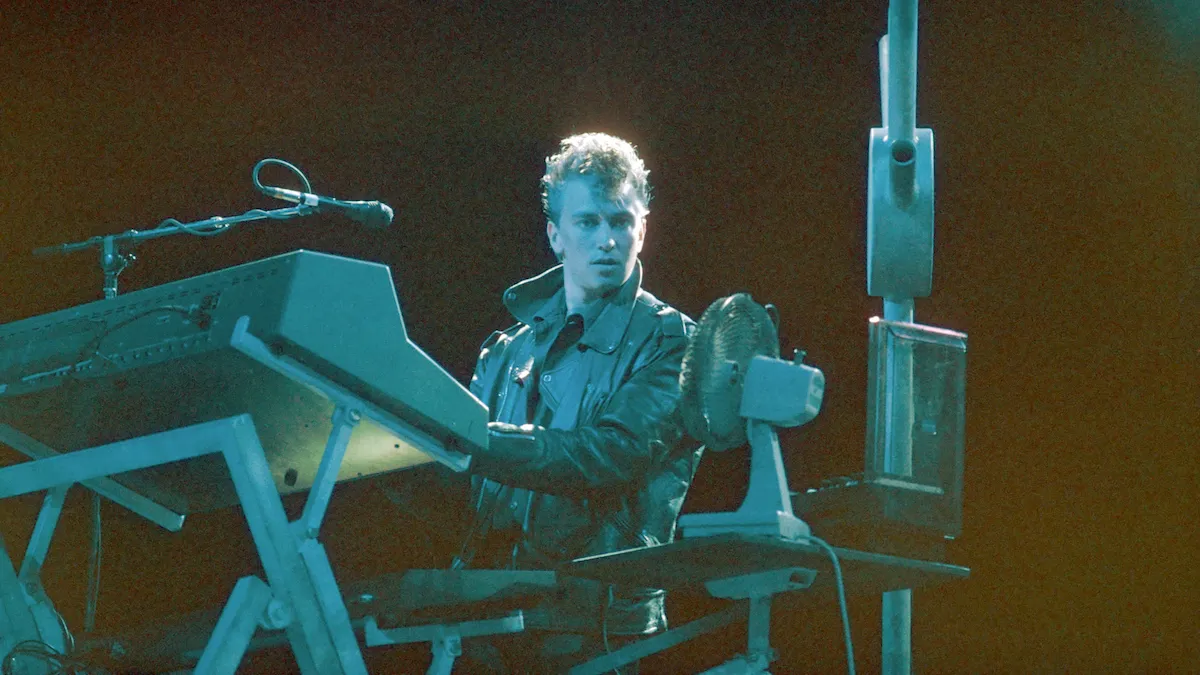
In September and October Conny made his first live performance on a Goethe Institute tour of South America. He played a DX7, a trumpet, the mixing desk, and an 8track tape of prerecorded backings; Dieter Moebius played an Arp Odyssey and an Oberheim synthesizer; Arno Steffens sang and played the Emulator II. "It was rhythmic and psychedelic electronic music" exuded Conny over the phone recently. "It was partly freeform, partly composed. I had an 8-track with me, mixed with sequences and sounds as a background and I used it in a dub-mix way so I had the possibility to change it in reaction to the other musicians." Fortunately, six weeks worth of concerts were recorded for a future album.

Conny lives in the outskirts of Cologne where he owns a beautifully remodeled farmhouse. In the adjacent barn resides his studio, its cozy control room over-powered by Monster JBLs, two 24-track Otari's, and two MCI computer-controlled mixing consoles. Since I was last there, however, Conny has replaced the MCIs with an automated custom console designed by Michael Tahl and Peter Lang. "I didn't want to buy an SSL (Solid State Logic), he says. "I wanted a toy that was faster than these other desks. When I work on SSL desks I feel like an accountant."

Spontaneity and interaction are the elements Conny seeks, even with computers. "I just got a new program to work with the Emulator II on my Macintosh, by Digidesign called Sound Designer to edit sounds, loops. I use the Linn sequencer same as in the 9000 but a separate unit which is nice because I can use it in flying mode. I don't like to think too much when I design a sequence. I can kick in or punch out notes like a dialogue with a machine."

A recent pilgrimage to Conny's Studio was made by the Eurythmics for whom Conny will be producing a live recording in Japan. Conny produced the very first Eurythmics record, In The Garden (RCA import only), before their electro-pop smash, Sweet Dreams (RCA). On their latest record, Revenge, Conny contributed some drum sounds. "It wasn't a session," demurs Conny. 'We were sitting around, exchanging ideas and being crazy."

For Conny, being crazy is what it's all about. "Craziness is holy," exclaims Conny, in the mysterious, dramatic voice he uses when he wants to be emphatic. "When I talk about this hip-hop music and what they do in New York, it's not crazy enough. It's attractive and they have sensations, but it's not crazy. When I listen to Charlie Parker it was crazy. When I listen to Charlie Mingus it was crazy, but this is not crazy. Craziness is something holy."

What was it like in the early days with Cluster, Kraftwerk, Harmonia, the Sky label?
At that time we all were influenced by English and American music. We also listened to Koenig, Stockhausen, Varese. I used to work with these people in '67, '68, and '69. Mauricio Kagel gave me a lot of ideas about sounds. In those recordings I worked with very academic musicians being very precise doing these sounds, and to me it seemed lifeless, and dry. I then tried to find people that looked in a different way to these materials, that tried to improvise with these dirty sounds, these electronic sounds -- to have a feeling like a jazz musician has to his instrument.

We often worked with cheap toys and used them in a strange way. We distorted a lot of things and filtered sounds very radically but we didn't call ourselves electronic musicians. We used any scratch on guitars, or noises on an instrument... we used pianos and scratched the strings and put echoes on them, and tried to find drastic or attractive elements that turned us on.

The first set-up of Cluster was interesting. We had five oscillators, a few tube distortion units where we sent the sound through the tube and could adjust the amount of distortion. We had echoes where you could change the speed of the echo in real time. We used normal organs and Hawaiian guitar; when you treat a Hawaiian guitar really heavy it sounds like electronic music. We used tape-loops. We had a quite complex setup of all these things that were mixed. Sometimes we worked with a drummer, sometimes with cheap Italian machines.

Ultravox told me that when they heard Neu and Harmonia records they got inspired by this because of the different point of view. I think Lou Reed and John Cale and the Velvet Underground were in a similar situation. They were very naive, exploring new things, using the old rock and roll but with different ears and different experience of heavy city life. You do something and you don't realize how good it is. When you talk to Lou Reed today he says he never realized how good this was. They just did it unconsciously, by accident, and later on found out how important it was to pop music.

We were also influenced by the Velvet Underground. When I got this "banana" record produced by Warhol, we were immediately influenced by that. We said this is a fresh approach. They didn't care about the beauty of sound, they just went for a basic feeling of a true situation.

In the last few years there's been a growth in producer/artists like Trevor Horn, Martin Rushent, Arthur Baker, who are virtually creating the music of the people they produce. You produce music yourself but under your own name.
I admire some of these producers because they handle sounds very well. What I don't like is that most of their work sounds constructed. They go for an immediate sensation. Is it attractive? Is it acceptable? Does it sound impressive?

To me music isn't just interesting sounds. There must be content, an articulation, a state of mind, that I feel from the music because music to me is like a person. To me it presents an interesting state of mind. I think this has gone out of some music so that becomes more mechanical. Fantastic designs — it's mannerism. I don't say that about all of what they put out. Some of it is beautiful, but that's very rare and some of them are not very conscious about the content of music.

I just worked with a famous disco producer in New York, Francois Kervorkian (who produced Kraftwerk's newest album, Electric Cafe, on Warner Bros.) and he was a very good engineer and very good mixer, but I noticed that he just was looking for impressive sounds. He wanted to be sure nothing was ever boring so that everything was up, up, up. After a while I said to him, "You're always going up, up, up and you don't have any dynamic anymore. You also have to come down to build it up again. How can you live under this pressure to be up all the time? It's crazy." It's like putting music through a limiter to keep every note on the same level. So nothing was quiet, everything was extremely loud.

Get Copyright ClearanceWant to use this article? Click here for options!
© 2008 Penton Media, Inc.

Back to Top