Audio Insider
Online Monthly Pass

Register for an Account Forgot your Password?

Most Popular


The EM Poll


This is not a scientific poll but a tabulation of readers responses and is purely just for fun!

See Past Poll Results

pop_quiz_button

browse back issues

Newsletters

emusicianXtra icon
EMSoftware update icon
MET Extra icon
eDeals Newsletter icon


Subscribe to newsletters here...

Conversing with Giants

Mar 1, 2008 12:00 PM, By Geary Yelton


         Subscribe in NewsGator Online   Subscribe in Bloglines

They Might Be Giants talks about their personal studios, production techniques, and tag-team songwriting.

BONUS MATERIAL
Read "Conversing with Giants: The Extended Interview"
Gear talk with They Might Be Giants

CURRENT NEWSSTAND ISSUE

Read the full Table of Contents for the issue on sale now! Click here

Subscribe for only $1.84 an issue!

Please tell us about yourself so we can better serve you. Click here to take our user survey.

Personal Studio Series

Mastering Steinberg's Cubase™

This special issue is not only a must-read for users of Cubase™ software, but it also delivers essential information for anyone recording/producing music in a personal-studio.

Click for more
EM Podcasts

Listen to these latest podcasts and more:
Mike Barbiero (Maroon 5, Whitney Houston, Gov't Mule) on mixing in his own studio. Go

What's New: Two sample libraries and an ambience-generating program. Go

eDeals Newsletter for Discounts on Gear

Get First Dibs on Hot Gear Discounts, Manufacturer Close-Outs and Job Opportunities when you sign up to receive eDeals E-newsletter, sent twice a month. Check out an issue get advertising info or subscribe

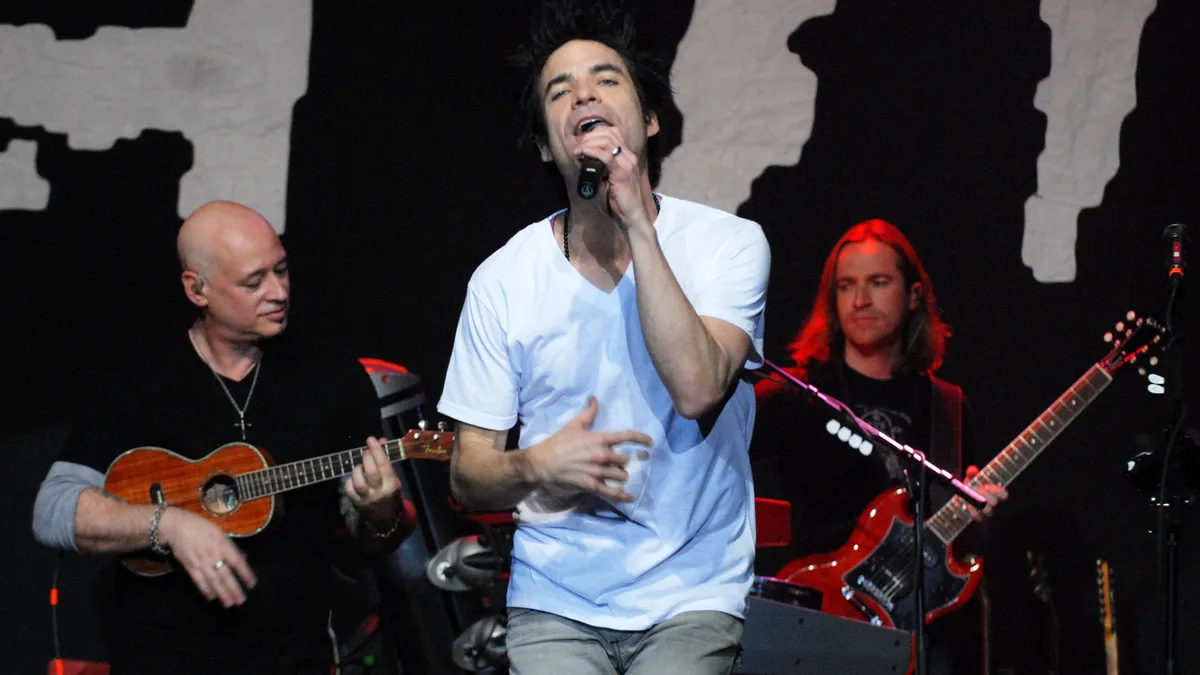
men sitting on floor with instruments

“If you can think up the lyrics and the melody and everything at the same time,” says John Linnell (left), “you’ve had some strong coffee. But I find it really challenging to make it all come together at once.”

IT SOUNDS LIKE THEIR APPROACH WAS THAT TIME, AND THEREFORE MONEY, WAS NO OBJECT — AND YOU OBJECTED TO THAT.

JF: Yeah, exactly. But they're extremely successful producers. They're very dedicated to doing outstanding work. We weren't trying to turn them into hacks.

JL: But they were very true-blue in their approach. They were not willing to accept an unfinished or mediocre project, and that was great. That part of it was exactly how we feel about it.

JF: I think one of my strongest memories was being up in Pat's room, like a little project room, where we were just doing some really crazy guitar overdub on “Withered Hope.” It was so weird — I didn't even really know what we were going for, and it was all on me, and it was just this totally wide-open, nutso improvisational thing. I didn't even know how John King was going to edit it together. It was just kind of unclear what we were doing, although the result actually seems quite purposeful. I remember saying, “I think that's good.” And John King, with this very crazy look in his eye, but very seriously, said, “It's good, but is it awesome?” I don't know. I don't know what awesome is.

YOU'VE WORKED WITH DILLETT FOR SO LONG. IS HE LIKE THE UNOFFICIAL THIRD PERMANENT MEMBER OF THE BAND?

JF: Yeah, he's like the third Beatle. He was an assistant engineer at Skyline when we were making Flood, and he worked with Nile Rodgers. Skyline was in many ways one of the studios in that last era of great New York studios that had a formal — I don't even know what you'd call it. Engineers were really taught how to work this certain way. It had more to do with the way people made records in the '50s and '60s than with the way things are made now. [Pat] comes at it with a lot of skills that you're not going to learn on your own.

AND YOU'RE DEPENDENT ON HIM.

JF: We're very dependent on him. The sonic things that really speak on the record are often coming from his side of things. And so when we went to working with the Dust Brothers, one of the things we wanted to do — since they were only working on half the record — was to avoid a sort of schizophrenic project. Pat and the band are consistent throughout the whole project.

THAT'S SOMETHING THAT REALLY IMPRESSED ME ABOUT THE ELSE. EVEN THOUGH VARIOUS PEOPLE PRODUCED DIFFERENT SONGS, IT ALL SOUNDS VERY COHESIVE.

JF: Yeah, well, it was all mixed by Pat. That was by design. From the experience we had with Mink Car, which was kind of a similar mixed bag, we just wanted to make sure that this had more sonic continuity.

YOU'VE WORKED WITH MAJOR LABELS — ELEKTRA BEING THE BIGGEST — AND YOU'VE WORKED INDEPENDENTLY. HOW DO THOSE EXPERIENCES COMPARE?

JL: Sometimes I think it's less and less relevant whether we're on a major or whatever. We've very much established the way that we like to work, and that is the principal thing — that we're kind of figuring out the scheduling and who's producing, what hours we're going to work, the atmosphere in the studio — things like that. That to me is the key ingredient: how we actually work day to day, not so much what organization is producing the record.

JUST HOW MUCH OF YOUR SONGWRITING TIME DO YOU SPEND TOGETHER?

JL: Not very much. Now, John mostly works up in the Catskills when he's writing, and I'm in Brooklyn; that's where my studio is. We write pretty independently, and we've had a number of tracks in the recent past where we've collaborated. The song “Mink Car,” off of [the album] Mink Car, we actually wrote sitting at a piano in this Leopold and Loeb sort of way. We don't really ever do that.

JF: More likely, these days it'll be handing off a file. Sometimes it's just small things, like specialty items that need to be addressed.

JL: Here's a sort of happy way that we collaborated on the last record. One example is I sent my demo of the first track, “I'm Impressed,” to John. I emailed it to him.

JF: MP3. Really lo-fi MP3.

JL: At some point I gave John the OMF, which just has the vocal and the drum reference and the chords. He took that and constructed a whole new track just behind the vocal. So he basically created a completely new track based on what I'd given him. Then we [brought] the OMF to Pat Dillett.

JF: Although what's funny is the vocal that's on the track is from the MP3. If you wonder how we capture that really crummy sound, it is that familiar sound of kind of a low-res MP3. We listened to [the vocal track], and part of it just had some slightly distressed effect on it.

JL: Sort of a murky sound to it.

JF: And combined with the original source and the effect, it did seem more interesting than just a straight vocal.

JL: I think the MP3 had the effects I had put on it in my home studio. The OMF we brought to Pat of the original full-bandwidth vocal didn't have the effects that I'd put on the demo. And we're like, “Well, how do we get these effects?” And Pat was like, “Well, why don't you just use this track — this perfectly good MP3 track?”

Get Copyright ClearanceWant to use this article? Click here for options!
© 2008 Penton Media, Inc.

Back to Top